Monday, 1 October 2012

2012 Centenary Cruise Week Meuse - Mouzon to Charmes


Fog on the Meuse
A quiet mooring
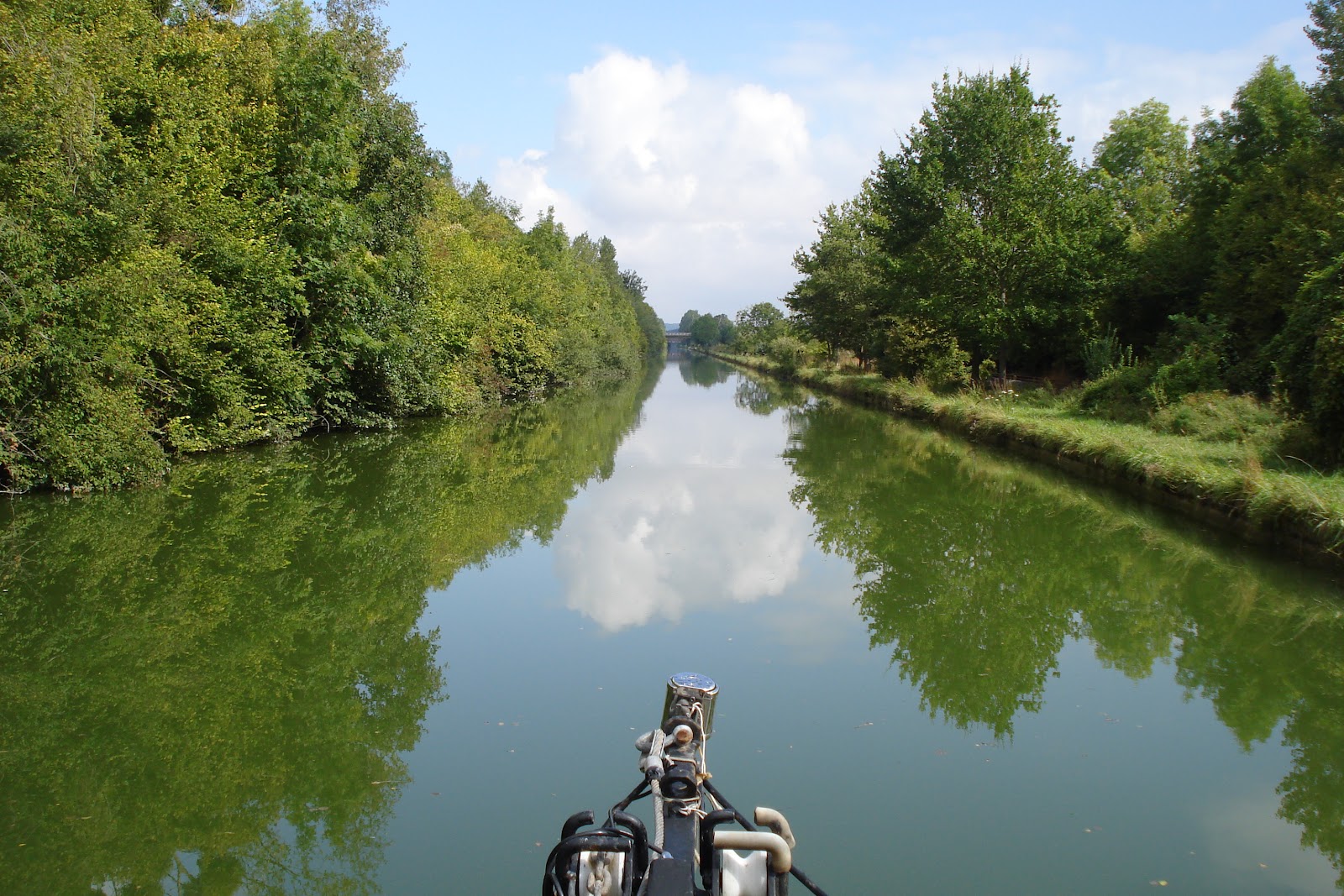
Monday dawns with thick fog. As we move out of Mouzon there is a foredeck watch and a top speed of 3km/h. Over the next hour it burns off to a clear, sunny Autumn day, a chance to do some painting jobs under way. David clears rust spots and repaints at the bow. Nick tackles the brasswork around the saloon door. The Northern section of the Canal de L'Est runs for 270km mostly along the River Meuse (of which we are doing 176km), among woods and farmland with more kingfishers to the km than anywhere I know. Monday night finds us at the Halte Nautique at Dun sur Meuse, with electricity, water and a SHOWER! Luxury. 

Bird spots include. sparrowhawk, stonechat, great grey shrike, red kite and many buzzards. As we follow the ridges to the South, there are more and more graveyards as we approach Verdun. Nick cycles to the memorials of the battles at Verdun in the 1914-18 war. We overnight on the town quay at Verdun. Linda has raspberry beer and we meet yet another eccentric restauranteur in a riverside Pizzeria.
 
Verdun Moorings on the quay
Working the non-automated locks
                                     
         
The locks between Verdun and St Mihiel are not automated and we are accompanied by a lock-keeper who could be our friend Max's twin brother. We found a launderette in St Mihiel, fuelled up from a garage, and said farewell to Nick who was off to London to exchange a berth on Jonge Jacob for a hotel in Park Lane! Progress was slowed by two broken locks the next day. As “Max” said (in French) “that's the way the pot heats up”. As a result we did not reach Troussey, and were stuck next to a cement factory for the night, before leaving the Meuse down a steep flight of locks to Toul. This section was made more stressful by the knowledge that there was a large commercial barge coming up. Luckily we did not meet him on the blind corner, where we hooted twice, very loudly. Here we were joined by an ex-colleague, Colin, for a couple of days, as we moved up the Moselle for a short stretch (broad still waters and wooded edges followed by the industrial wasteland of Neuves Maisons). Still behind on our schedule we raced up the first 15 locks of the Canal des Vosges, only to be trapped at 1800, two locks short of Charmes. Undaunted, we tied to a tree, and walked into town for a shower at a camp site and a real three course meal in town. Now that we are on the Canal des Vosges we have to climb to the summit ahead of us, and we have 260km to go to St Jean de Losne. It is looking more likely that we will stop at Corre, where we reach the Saône in 100hkm, and finish off later in the Autumn. We will have been on the move for four weeks, our VNF pass will run out and other duties are calling.

Tuesday, 18 September 2012

2012 Centenary Cruise Week 2 Péronne to the Meuse (Mouzon)


After enjoying the sunshine of Péronne we set off once more on Monday with a less encouraging forecast. Half a dozen locks, one tunnel and 45 km brought us to Noyon at the junction of the Canal Latéral à l'Oise. Here the gas ran out. Changing from UK Calor to european gas means changing the pressure regulator, but as luck would have it we were moored next to a garden centre that could provide all we needed by 0930 the next morning.

Tuesday brought cold and rain, and we were stuck at the first lock for over an hour waiting for commercial barges to go through. By 1300 we had completed only 3 locks and 350 metres, so by evening we had completed only 28km, mooring at Guny. The consolation was that we were now in the much smaller and attractive Canal de l'Oise à l'Aisne. Suddenly there were kingfisher, heron, buzzard and jay everywhere, and although the weather was still uncertain, we pushed on to the halte nautique at Bourg et Comin (just a pontoon by a field but at least there was free electricity). By this time we were beginning to have some problems with the 24 volt alternator, which meant trying to conserve our service batteries, not using the bow thruster or autohelm, and leaving the fridge off until we could reach mains electricity.

The direct canal route south passes through champagne country and Reims, but repairs to locks in this section meant taking a longer diversion either via Paris or via the Ardennes. Leaving Paris for another trip we set off up the beautiful Canal des Ardennes. The canal is much narrower, winding through dense woodland, climbing into the Ardennes hills, giving a real feeling of isolation. By 1900 we were one lock short of the village of Chateau Porcien when the lock system closed, leaving us tied up alone for the night once more.
A lunchtime halt
The next day was a little brighter and warmer. We stopped at the small town of Rethel for fuel from a garage (transported in 20 litre containers balanced on our bikes) and supermarket provisions. These included a bottle of Champagne to toast (rather belatedly) 500km completed on the trip so far. Evening found us in the Halte Nautique at Attigny, eating at a Pizzeria run by a most peculiar and grumpy couple. This theme, incidentally, was continued by the stroppy waitress in Bourg et Comin and the unhelpful camp site manager in Sedan. In an area which is clearly facing hard times, you might think that tourist income would be welcomed, but we repeatedly found that basic information was not provided and elementary services were closed. French tourism take note, although it must be said that most French people we met were friendly and helpful, and admired our boat.

As the Canal climbs into the Ardennes there is a steep flight of 27 locks in less than 10km, some of them only 100 metres apart. Nick stayed with us for this day so that we could have one crew member ashore to handle lines and activate lock mechanisms. The flight took us over six hours (meeting a commercial barge on the way down at lock 23) but by nightfall we were at the small village of Chémery sur Bar, sharing a beer in a bar straight out of a horror movie, featuring France's last remaining toilet without a seat, a landlady with no teeth and a display of pornographic videos for hire. We did not linger.

After days in the forest we were looking forward to reaching the Meuse, partly because we would finally turn south, and partly because the city of Sedan offered luxuries like showers, electricity, fuel and a meal out. The last few km of the Canal des Ardennes were idyllic: gentle rural scenes of “mists and mellow fruitfulness”, before meeting a lunatic hire boat careering round a blind corner which resulted in the loss of our fresh herb planter. At Sedan, Edwards-May in “Inland Waterways of France” suggests both the town quay and the berths at the camp site which we had used in 2007. Well the town quay was silted up and unusable, and the pontoons in the camp site were closed. Apparently no boats are welcome in Sedan after 15 September, and boats of any size are not welcome at any time (the pontoons being much too light for our 30 tonnes).
Mouzon Boulangerie - note the bikes outside
So it was that our week ended 15km further on at Mouzon, where the halte nautique was also closed, but the electricity was still on, even though the toilets and showers were locked, and the water taps were dry. But the lady in the boulangerie was delightful, and at least our route had turned inexorably south, towards Verdun, the Moselle, and the Saône.

2012 Centenary Cruise Week 1 Woodbridge (Suffolk)to Péronne


After a frantic week of preparation, Nigel Askew and David boarded De Jonge Jacob on Friday 31 August to undertake the sea passage to Dunkerque. The calm Saturday which had been forecast all week was changing, with the shipping forecast offering SW 5-6 for Thames, so we postponed. A flat bottomed boat like ours is not safe at sea (nor insured) in anything over a 4. Sunday showed an improvement SW 4/5, so we were hopeful for the Monday. In the event we both slept through the 0515 shipping forecast but a call to Lynne Askew showed SW veering NW 3 or 4, occasionally 5 at first. Since it was almost calm at 0630 we weighed anchor and set off for Felixstowe Ferry.

Once at sea the promised force 4 arrived, producing an uncomfortable rolling trip past Cork Sand and Roughs Towers, and an even more lumpy sea with wind over tide down Black Deep. The plan had been to pass through Foulgers Gap, a narrow passage through Long Sand, but the building of the London Wind Turbine Array has closed this option, so we were forced to plod on to Fisherman's Gap, a further three miles, before easing away towards the Kent coast. As the tide turned the wind dropped and we had a sunny end to the trip, arriving at Ramsgate at 1900, in time for a Thai meal out and an early night. 51.7 nm run.
Next morning was misty and light and after a cooked breakfast in a cafe, Nigel and David set out along the Ramsgate channel past Goodwin Sand, heading for the shipping lanes. The sea fog had lifted though patches still threatened, and we saw little shipping for the first two lanes. After Sandettié light that all changed, with eight vessels on slightly different courses and speeds all appearing in 20 minutes. No AIS or or radar for us, not even a chart plotter, so it was hand compass bearings every five minutes and a delicate pirouette round a Maersk container ship rather than pass ahead of her. From there it was straight across the sand banks, watching the echo sounder, as the French coast appeared. We made the Dunkerque approach channel opposite the Western Docks, and we were a mile short of the Dunkerque breakwater when the engine overheated, causing an abrupt change of speed and a late entry to the port at 2030.Day's run 48nm.
Dunkerque Harbour

That evening we met Linda off the train, and Nick Brown who was to accompany us on his bike for the next few weeks. The four of us ate on board at about midnight. De Jonge Jacob had performed well at sea, and was now to re-enter fresh water, which is more her natural environment. As an inexperienced crew, Nigel too, has had a challenging experience, which I hope he enjoyed. He set off first thing to return to UK. Many thanks to him for stepping in at the last minute to crew a boat he had hardly seen a week before.
On Wednesday morning we motored over to Trystram Lock, the first of three locks into the French canal system. By 1520 we were through them all, with new provisions on board, heading for Watten, the junction with the main commercial canals. Nick travelled on board with us on this first day, undertaking a training course in rope handling and lock procedure. We saw our first kingfisher of the trip at 1545, and apart from a grounding in a shallow patch avoiding a push-tow (one 250 tonne barge pushing another) arrived at Watten 30km away. 

Watch what's coming out of the locks
Inland, distance is measured in km, not nautical miles, so the log is changed. There is little in the way of facilities in Watten although we found a pizzeria/crèperie. This area is generally industrial and lacking much charm. We saw only three pleasure boats in the next three days, but dozens of barges carrying animal feed, coal,aggregate, fuel, recycled glass and metal. Commercial traffic takes priority and stopping points cater for 40 metre boats, not 15 metre ones. Over the next two days we passed through industrial wasteland, chemical works, factories, closed coal yards around Douai, Lens and Bethune. The economic fortunes of the area are poor at best, worse still in the present climate. Gradually as we moved south the landscape improved – agricultural rather than industrial- and small military cemeteries appeared in the middle of fields that were hell itself in 1915-17. We were on the canalised Escault, where David's grandfather saw action (and won an MC) in 1917, and then on to the Somme itself.

Entering Ruyaulcourt Tunnel 4.3km
 Locks came thick and fast, all designed for the huge commercial barges, as well as the intimidating 4.3km Ruyaulcourt tunnel. This has a one way stretch at each end, with two way traffic for 2km in the middle. The big barges can only alter course by a burst of engine power, one of which forced us into the side with the loss of a fender. No question of going back for it.


By the weekend we had reached Péronne, an historic small town with moving exhibitions about the trenches, and even a band of Highland pipers. De Jonge Jacob has completed 355km from Waldringfield, the sun is still shining (close to 30 degrees on Sunday as I write),and we have a day off. We are on our way.

Sunday, 19 August 2012

2008 to 2012 Living in Woodbridge

From June 2008 to September 2012 "De Jonge Jacob" stayed at Robertsons Yard in Woodbridge. Katy and Alex were resident from 2008 to April 2010. Two hard winters living in a tin can persuaded them of the joys of life ashore, and they moved to a cottage in Ipswich.  While their lives moved on - a wedding in July 2011 and a house purchase in May 2012- the boat stayed put.
In 2012 the other two owners David and Linda Cadwallader bought out Katy andAlex's shares in the boat, and plans were made for the next stage of the boat's life in sunny France. The hull was epoxied (waterproofed) in 2011 and new leeboards were made in oak by Robertson's. (See their web site for details). The engine was overhauled, and as August 2012 approached the boat was again made ready for sea....

De Jonge Jacob in 2012. This was her centenary so we made a special flag for the trip


Friday, 4 July 2008

2008 Newhaven to Woodbridge

After graduating from Sussex, we decided to take De Jonge Jacob up to the River Deben in Suffolk, where half of our crew wished to recreate the lazy summers she had spent growing up, pottering about in boats and living on, in and around the water. This is the diary of our trip from Newhaven, East Sussex to Woodbridge, Suffolk.

Thursday 5th June 2008Between our mooring at Peter Leonard Marine and the open sea was the swing bridge, which restricts its openings to just before and after high tide, so we were only able to get under way at 1pm - we left surrounded by a fleet of little yachts, but we quickly parted ways as we sailed past Newhaven Marina and made our way down the coast.

The wind was blowing a gentle 3 from the West, and the sun was shining - perfect conditions for Jacob in open water. We spent a glorious day, rounding Beachy Head at 3pm, and then staring at Dungeness as it approached us painstakingly slowly for the next 7 hours. Eventually, at 10pm, we put it behind us, and put on a few extra layers of clothing for the night watch.

The twinkling lights of Folkestone, Dover and Deal floated eerily past in the black, the wind got up a bit and there was some mild fog. East Sussex and Kent radio cheered us up with some jazz for a while, but we were starting to get thoroughly cold and damp at 4am daybreak, so Ramsgate seemed a good place to head into and get some shut-eye.

Sunday 8th June 2008
And Ramsgate was where we stayed for the next 3 days. It rained solidly, and the fog was horrendous, which is unpleasant for travelling and dangerous for crossing the Thames estuary - instead we explored Ramsgate. The consensus was that it was a lovely seaside town (even in the drizzle), although could do with a bit more TLC: the harbour wall was impressive, and we had a very enjoyable drink in the Royal Temple Yacht Club, from the window of which we could sit and admire Jacob, and look out at weather raging at sea.


Finally, on Sunday, we were able to push on. We moved over to the fuel barge to refill our tank at 1pm, and had an exciting moment getting off it as we reversed backwards and our stern was caught by the current and swung round towards some very expensive-looking powerboats. The trick in these kind of situations is to pretend to the rest of the world like you're intentionally following a carefully executed plan: a large burst in forwards and some heavy-handedness with the rudder, and we swung round in a perfect circle, missing the boats to port and the fuel barge to starboard, and chugged off in forwards out of the marina. The crowd watching us in the cafe nearby must have been very impressed.

Crossing the Thames estuary. Keep a good lookout!
Visibility was still a little on the poor side, but with a force 3 northeasterly and not a cloud in the sky, we left Ramsgate at 1.40pm to cross the Thames estuary, hoping upon hope that we weren't mown down by an enormous tanker looming out of the mist. In fact, we came across three tankers, all very close together, and, after having slowed down, changed course and strained our eyes looking through the binoculars for half an hour, we discovered that they were anchored. We carried on past, taking advantage of their stationary position to have a good look at these beasts of vessels.

The wind dropped to practically nothing at 3pm and the sea became dead calm, so in order to relieve the boredom our GPS decided to entertain us by stopping. Not to panic, we had a spare, but we fiddled with it for an hour anyway before replacing it entirely. The mist worsened, despite the sun, and Jacob pushed his way through the mirrored surface of the water as we ticked off the buoys on our path: Elbow, Outer Tongue, Long Sand Inner, Black Deep 2, Sunk Head Tower, NE Gunfleet, Medusa. They sounded as if we'd sailed into a Pirates of the Caribbean sequel - Johnny Depp was sure to turn up at any moment. We reached Harwich and the Port of Felixstowe as the sun was going down at 9.30pm, the giant crane monsters silhouetted dramatically against the red of the sky.

Monday 9th June 2008

We left our berth at the Halfpenny Pier at 11.30am, waving goodbye to the gentlemen with the traditional sailing yacht, who we learned had made the same journey as us from Shoreham to Ramsgate to Harwich, in the same time frame. With some trepidation we crept through busy Felixstowe port, and slipped down the East Anglian coastline in yet more sunshine.

At 1.30pm we reached the bar at Felixstowe Ferry. Unfortunately this was not the kind of bar we could sip a pint in, but was instead an infamous bank of very solid shingle, the bane of the Suffolk dinghy-racing community, and was feared by two of our crew who knew only to well what could happen in these rough waters to the inexperienced mariner who crossed the bar at the wrong time, in the wrong place, or in the wrong weather. Our final crewmember remained blissfully ignorant as Jacob's rudder pulled in the swell of the current and we were buffeted to and fro just a couple of metres above the ridge of the bar. Years of practice in boats a fifth of Jacob's size served us well, though, and we entered the Felixstowe Ferry moorings, passed the Horse buoy, commenting on the games of cricket played on the Horse Sand in the middle of the river, and, despite this being Jacob's first trip up the Deben, it felt very much like a homecoming.

A mere hop, skip and a jump down the river we anchored at the Rocks for an hour or so, as we had to wait for the tide to have enough water to enter our berth at Woodbridge. One crewmember went out in a tiny inflatable dinghy to clean up some rusty patches, the others sunned themselves on deck. At 4pm we upped anchor, passed through the moorings at Waldringfield, wound our way round the channel buoys at Troublesome Reach, treaded softly through the moorings at Woodbridge, and rounded the corner at Robertsons boatyard at 5.30pm. We berthed at Robertsons quay, secured the lines, and went off in hunt of supper.

Tuesday, 13 November 2007

2007 September From Dunkerque to Newhaven

Friday 21 September 2007

We were finally able to leave Dunkerque on Friday, and made our way through the canals to Calais. It took all day, and unfortunately we arrived at 8pm, just as the Calais lock-keeper was leaving for his dinner! Not wanting to intrude on his evening meal, we moored up by the canal-side on the wrong side of the lock at Les Attaques, and the lock-keeper promised us faithfully that he would be back by 8am to let us through.

Saturday 22nd September 2007

He was only a bit late.

So there we were on Saturday morning, eager to take advantage of our weather window - strong winds were forecast for Sunday, but Saturday was glorious. Blue skies, no wind, calm seas - perfect for three experienced boaters, but unpracticed bargers to begin our maiden voyage across open sea. We motored on to Calais Port. David got on the VHF and spoke to the cheery French harbourmasters, who said that we were clear to exit the port, and that we should follow the two ferries ahead of us. This experience was more than a little scary as the ferries were enormous and unpredictable. This seemed like a good time to enhance the fun by dropping the mast, and then rehoisting it when we decided that mast-up would be good for stability. The learning curve was as steep as the waves coming off the stern of the P and O ferry in front.

Being out at sea was wonderful. The day was calm and gentle, and the motion of the barge was soothing - at least it was for some of us - Alex became a little peaky. The sun was beaming down, and some crew members began to shirk on their chores.

Dover was only 20 miles away, and very quickly we caught sight of the white cliffs. We crossed the shipping lines (some of the busiest in Europe) without much ado, and imagined the Dover Coastguard watching us on his radar screen, as we turned at 90 degrees to the shipping highway, and scurried across it like a hedgehog.

Our destination was so close, and yet so far. Day turned to night, and suddenly, in contrast to our lazy sunny day, we began to worry about navigation lights and lobster pots. This was particularly pertinanent as we approached Eastbourne at 1am (to fill up with fuel, and catch a couple of hours shut-eye). The Harbourmaster told us thier facilities were 24h, and that we could moor up in the sealock for a while if we wanted, but look out for the lobster pots because there are a lot of them around the harbour approach and they're not lit. Neither, as it turned out, were some of the buoys. Motoring over a lobster pot, and hearing the propellor grind to a halt, and knowing that there was no way we'd be able to unravel the rope caught up in it, and realising that if this happened we'd be stranded floating in the blackness of the sea in the middle of the night with strong winds and high waves just around the corner - these were the unsaid worryings of the brave crew of Jacob. But despite a few close calls, and with a lot of Alex waving a torch about at the waves, we berthed safely at Royal Sovereign marina, refuelled, and went to sleep.

Sunday 23rd September 2007

Three hours later, all but the laziest member of the crew were up and about, and putting Jacob to sea once again for the final hop, skip and a jump down the coast to Newhaven. Kate got up at 6am, in time to see the sun come up over Beachy Head. We passed the Seven Sisters and counted eight, and arrived two hours early at the Port of Newhaven. The wind was beginning to get up, and the sea was getting choppier. We called the Harbourmaster on the VHF, and told him that we were a flat-bottomed boat, that the waves were getting bigger and knocking us around, and could we please enter the port, tie up temporarily and wait to be let through the bridge to our new mooring? He said no. The waves got bigger. We did it anyway.

There was a seagull perched on a rather delapidated sign, reading "Welcome to Newhaven". The Port Authority told us to moor alongside the jetty by the swing bridge, but the jetty sported a sign saying "Keep Clear - minimum distance 12m". It was suitably confusing, and we were tired, and cold, but eventually the bridge opened, and we officially arrived.


And a full English breakfast does wonders for the tired and cold.


Saturday, 20 October 2007

2007 September First Journey - Workum (NL) to Dunkerque

Log of the journey between Workum, the Netherlands and Newhaven, the UK.We started this journey after taking over De Jonge Jacob from his previous owners. After finding this beautiful boat that was also ideal to live aboard, we now only had to move it to its new home the UK. One of the main worries we had about this journey was the limited amount of time we had: this was a new boat that we had never sailed before - what's more, none of us had any experience with flat-bottomed boats either. We did not want to cross the channel in bad weather because we didn't know how this boat would fare on the open sea - after all, it's an inland water boat. However, by the time we started the trip it was the 8th of September. The weather would slowly become more instable and we only had until the 25th to get across the channel. In the end we managed alright and pretty much everything went smoothly...

Saturday 8th of September 2007
We finally left Workum (or, more precisely, the Workumer Jachthaven, where De Jonge Jacob had been taken out of the water for a repainting of the hull), only to be delayed about 200 meters by a railway bridge - for 3/4 of an hour... We were taking it slowly that day, but found that the boat was handling fine. After about 6 hours of motoring we moored in Groote Brekken on a mooring station, in a force 5 wind. The night would prove to be quite rough, but definitely cozy. This first day we had traveled a phenomenal 28.8km! But at least we were starting to feel comfortable with our boat.

Sunday 9th of September 2007We set off at roughly 9:20 to go further south. Pretty much our first obstacle was our first lock - the Lemmer lock. Even though we were quite nervous we passed it without troubles. After this we proceeded further south, past Urk, through the Ketelbrug and the Rogebotsluis to Elburg, where we arrived at 17:30. Elburg was a pretty little town that has a potential free mooring if you leave early the next morning. Furthermore, Elburg was the hometown of the shipbroker that negotiated our purchase! We traveled 60.7km that day.

Monday 10th of September 2007
After leaving Elburg in gray weather at 8:20, we moved on to Hardewijk. Here, we moored in a small lagoon (with lots of mud kicked off the river floor as we went in, suggesting that it wasn't very deep!) , sheltering from the bad weather for a while. After a nice breakfast we moved on past the Nijkersluis at 14:30. After the wind increases to force 6 we decide to stop in Almere Jachthaven, where we add some water and fuel. Almere is a quiet and modern city that lacks character, but boasts a good Greek restaurant with Veggie options.


Tuesday 11th of September 2007
We get to Muiden early in the morning and take a break at 11:47 after passing through the Lock. Muiden has some amazing boats - including 3 masted tjalks and a caravel... In the afternoon we travel on to Vrouwenakker where we were unable to continue due to the bridge not opening. We moored up on the riverside after travelling 48km.


Wednesday 12th of September 2007
We tried leaving early (8:00), but alas! Destiny was not with us and we were stuck at the bridge 'til 9:10! We finally continued our journey and passed through two tiny bridge openings (not wanting to wait for the bridges to open) - they were roughly 2.5m high and 4.5m wide! Luckily our boat, with mast down, is only 2.35m high (we made veeeery sure we knew how high it was before going through these two...), and about 3.5m wide. In the end we traveled 77 km that day and moored up for the night in Streijensaas, past the Julianasluis en Dordrecht.

Thursday 13th of September 2007
Getting more and more used to the rhythm of boat life, we left Streijensas at 7:15 and travelled down to Vlissingen. Our hope was to get across the shipping lanes past Vlissingen to Breskens, but we weren't sure whether we'd make it. We arrived in Vlissingen at 20:00, after having to pass through 5 lifting bridges in short succession. We decided that Breskens would be better and erected the mast whilst approaching the sea lock (which shows how wonderfully constructed the boat is!). We crossed the shipping lanes in the dark, with strong tides pushing us inwards, and wash from big container boats shaking us up. It was quite a scary experience!
We finally arrived in Breskens at 21:00, where we changed our log to nautical miles. That day we traveled 98km, bringing us up to a total of 369km for the whole trip - that's 199nm.

Friday 14th of September 2007
We left Breskens at 10:34 after buying - now that we were going to travel along the coast as opposed to on rivers - a liferaft and some flares. Nonetheless, after travelling for an hour we found that the wind, blowing at force 4 into us with the help of some tide, was slowing us down to about 3k/h. We decided to go back to Breskens. At 12:30 we moored for that day - we traveled a grand total of 8nm (without making any distance for our journey...).

Saturday 15th of September 2007
Determined to make up for the time lost the previous day, we left at 7:05. The weather was looking a lot better that day, only blowing a force 3 in a clear sky. We traveled quickly for roughly 5 and a half hours after which we had to change our course slightly. We then traveled at 6.7k/h until the tide changed at 14:00. We approached Dunkerque doing 3.5k/h. Deciding that there was no point in going on to Calais against the tide we stopped in Dunkerque in the Port du Grand Large at 16:50. That day we traveled 63nm.

Sunday 16th of September
Our plan was to travel via the inland water canal to Calais in order to avoid the rough weather along the coast. We were also hoping to pick up a visitor along the way. An ambitious plan that proved to fail from the outset... After missing the lock opening leading into the inner harbors of Dunkerque at 10:20 (because of incorrect signposts and unhelpful people/malfunctioning VHF transmitters), we picked up our visitor...in our mooring at the Port du Grand Large. We finally moved beyond the lock at 15:15 and tied ended up just outside Dunkerque next to the ecluse de jeu de mail at about 17:00.

After traveling for 8 days non-stop and traveling over 250nm in total, we found ourselves stranded in Dunkerque for a week. One of the crew members had to return home for a week and travelled back with our visitor. Both Kate and me were sad at first about having to stop in Dunkerque, a stone-throw away from our destination, Newhaven (on the map at least). In the end we learned to love Dunkerque and appreciate its quirkiness (a kind of very industrialised quirkiness...).

We would travel on that Friday, the 21st of September, which will be documented in our next post.